

Pollet Group
 |
Pollet Group · Theoretical Nanophysics
Quantitative answers for strongly correlated quantum matter
|
3 research fields | 4 core methods | 2011 in Munich since |
 |
 Quantum Matter |
 Quantum Simulation |
Where three fields meet
The research in our group is situated at the boundary between cold gases, condensed matter and computational physics. We are interested in first-principles quantitative approaches to strongly correlated many-body systems. Combining these three fields often offers a new perspective on long-standing problems. |
What we work on
Cold Gases Ultracold atoms as quantum simulators: clean, tunable and controllable. We deliver the quantitative benchmarks these analog devices need. | |
Condensed Matter Helium-4 and supersolids, disordered bosons and the Bose glass, dimensional crossovers, Rényi entropies and entanglement. | |
Numerical Methods Quantum Monte Carlo and embedding techniques – from worm-type path integrals to sampling the Feynman series. |
Active research topics
group researchers : Tomas Kreißel, Lechen Xu, Lode Pollet
associated members: Naïmo Davier, Ludovic D. C. Jaubert,
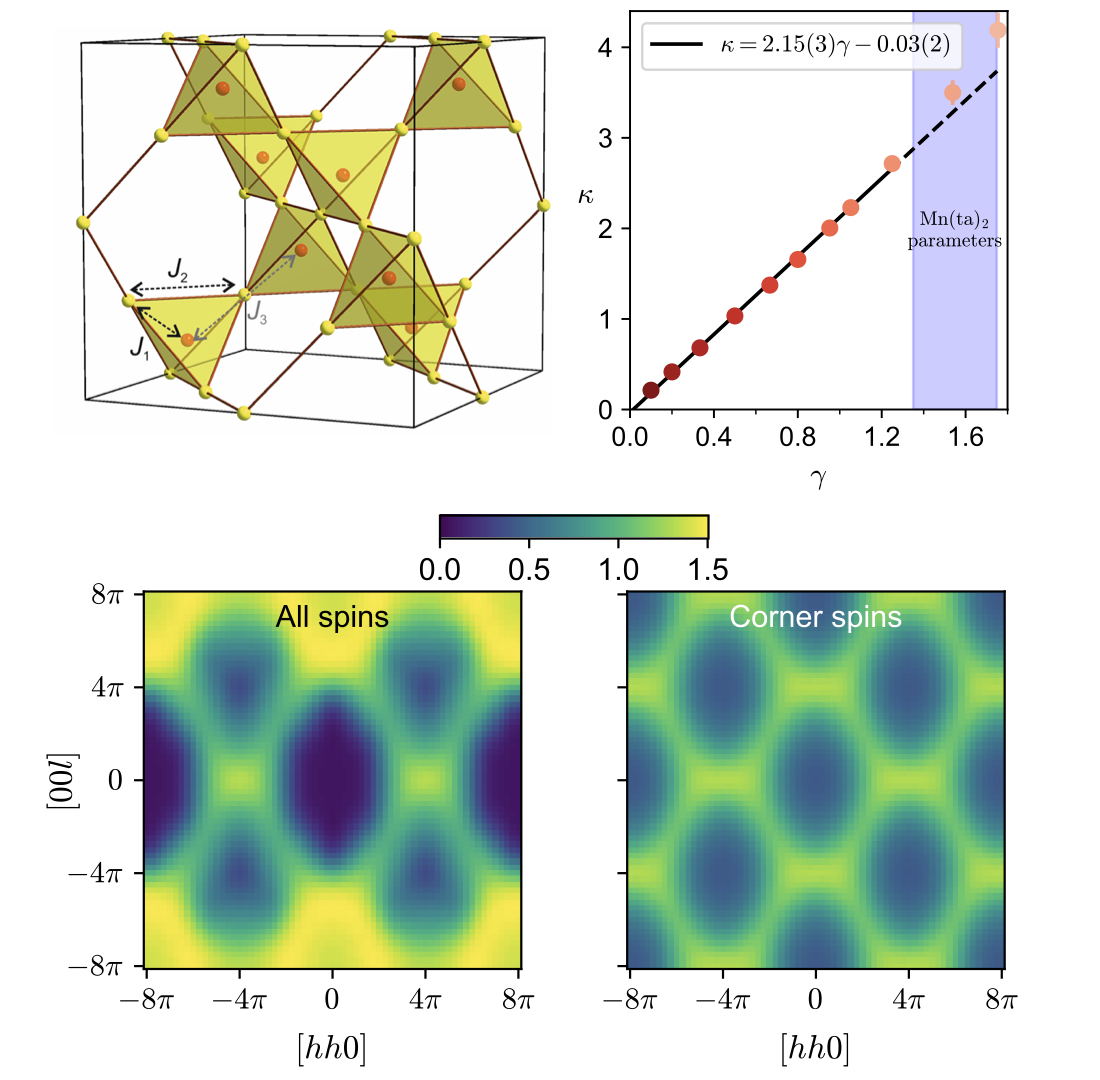 The centred pyrochlore lattice is a novel highly geometrically frustrated model characterized by a rich phase diagram at low temperature. This was identified as the molecular design in metal-azolate framework [Mn(II)(ta)2], with the frustrated regime depending on the interplay between nearest neighbour and next-to nearest neighbour interactions (respectively with interaction strength J1 and J2). Through a combination of analytics, numerics and experiments we found that, at a particular interaction regime, the reciprocal space structure factor S(q) is characterized by finite width bowties, also referred to as pinch points, which are found to arise from the correlations between spins residing at the vertices of the tetrahedra. The width of these bowties was found to scale linearly with the ratio γ ≡ J1 /J2 up to γ=1.25. We are currently studying the properties of other, more qunatum MOFs defined on the pyrochlore lattice, as well as the quantum properties of 2D centered lattices such as the centered Kagome lattice.
References:
- Phys. Rev. B 112, 144437 (2025)
Many-Body physics meets digital qantum computing hardware
group researchers : Alberto Cavallar, Francesco Nappi, Lode Pollet
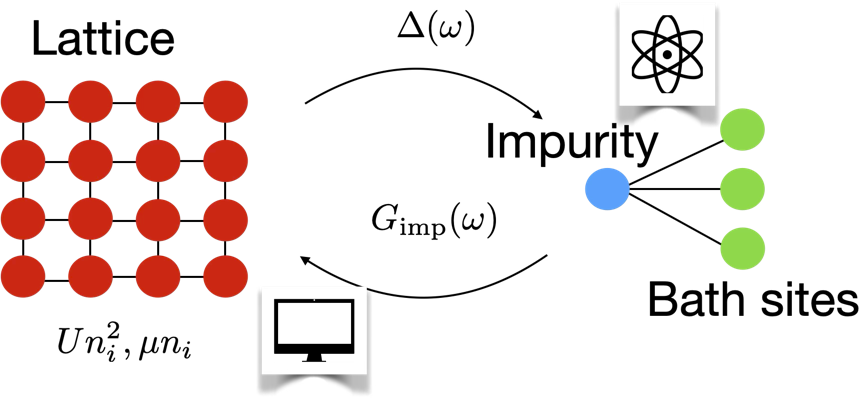
The group actively participates in finding applications of strongly-correlated many-body physics to digital quantum hardware. We implemented symmetry protected phases (SPT) on trapped ion experiments in collaboration with the University of Innsbruck through the cluster model and MPS representations of spin-1 Haldane order. Our previously developed machine learning algorithm (TK-SVM) was then able to learn their string order parameters without prior supervision and unambiguously discriminate them from topologically trivial phases. We are also interested in computing thresholds for quantum error correction, as well as embedding impurity models self-consistently on quantum hardware (see figure)
References:
- Phys. Rev. Lett. 129, 230502 (2022)
- Phys. Rev. Research 6, 013304 (2024)
- arXiv:2512.22888
- arXiv:2408.05017 (2024)
group researchers : Ali Otaifi, Yaxuan Zhang, Jinxin Federico Villadiego Forero, Lode Pollet
associated: N. Y. Yao (Harvard) and his group
Quantum spin liquids are elusive long-range entangled states. Motivated by experiments in Rydberg quantum simulators, recent excitement has centered on the possibility of dynamically preparing a state with quantum spin liquid correlation even when the ground state phase diagram does not exhibit such a topological phase. Understanding the microscopic nature of such quantum spin ``lake'' states and their relationship to equilibrium spin liquid order remains an essential question. Our group studies the equilibrium (through quantum Monte Carlo) and dynamic (through neural quantum network states) properties of such systems for various setups, with the long-term goal of realizing non-abelian anyons in a quantum simulator setup.
References:
- Phys Rev Lett 134, 086601 (2024)
- arXiv:2512.09040
associated: S. Linsel, A. Bohrdt, F. Grusdt, L. Homeier (LMU- Boulder)
 The toric code is a paradigmatic example of lattice Z2 gauge theory. But how to detect such order in a quantum simulator? What is the precise meaning of the equal-time string correlation functions? What is the meaning of (de)confinement and what is the meaning of topological order? How does percolation relate to this quantities? In this research unit we investigate the fundamental questions of Z2 lattice gauge theory, and have provided an open-source quantum Monte Carlo code of the toric code subject to longitudinal and transverse magnetic fields.
References:
- Phys. Rev. B 110, L241101 (2024)
- PRX Quantum7, 010332 (2026)
- arXiv:2510.14781
Spin Squeezing
group researchers : Lode Pollet
associated researchers: N. Y. Yao (Harvard) and his group
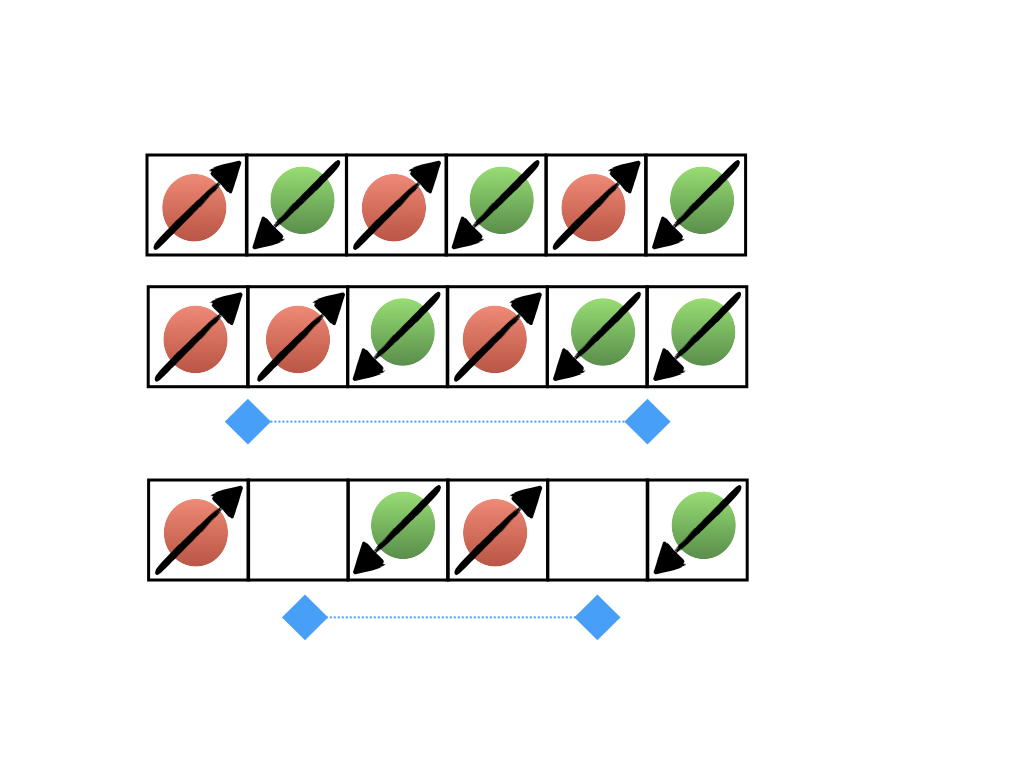
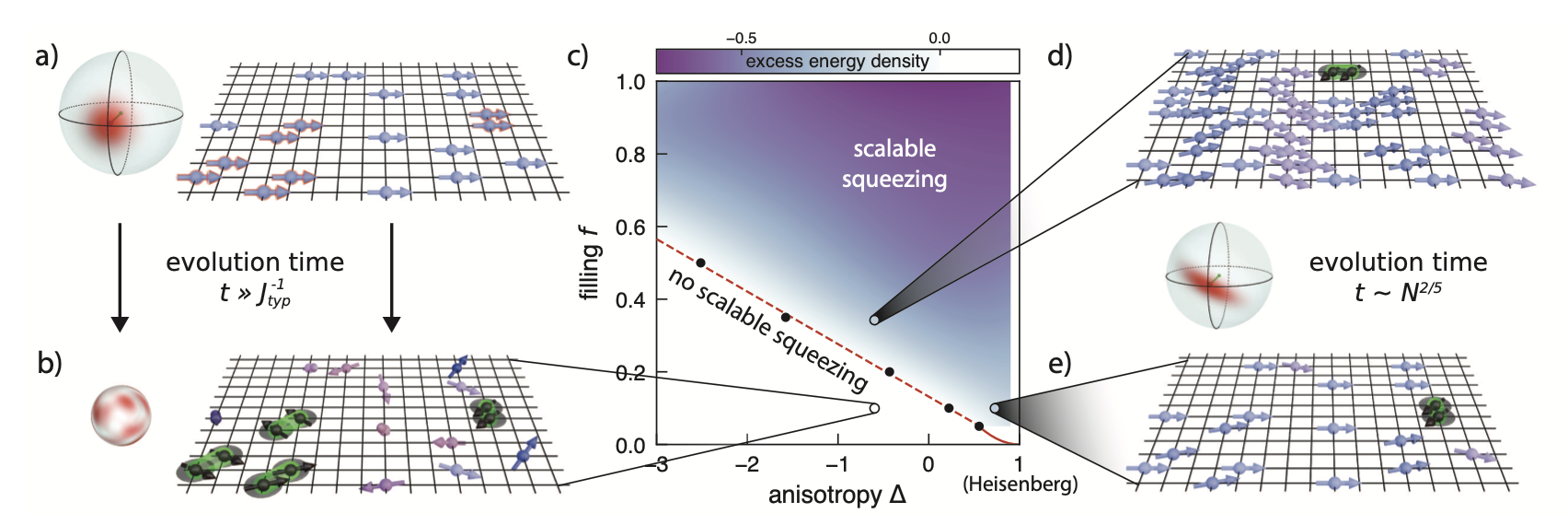 Spin squeezed entanglement enables metrological precision beyond the classical limit. Understood through the lens of continuous symmetry breaking, dipolar spin systems exhibit the remarkable ability to generate spin squeezing via their intrinsic quench dynamics. To date, this understanding has primarily focused on lattice spin systems; in practice however, dipolar spin systems—ranging from ultracold molecules to nuclear spin ensembles and solid-state color centers—often exhibit significant amounts of positional disorder. We develop a theory for scalable spin squeezing in a two-dimensional randomly diluted lattice of quantum dipoles, which naturally realize a dipolar XXZ model. Via extensive quantum Monte Carlo simulations, we map out the phase diagram for finite-temperature XY order, and by extension scalable spin squeezing, as a function of both disorder and Ising anisotropy. As the disorder increases, we find that scalable spin squeezing survives only near the Heisenberg point. We show that this behavior is due to the presence of rare tightly-coupled dimers, which effectively heat the system post-quench. In the case of strongly-interacting nitrogen-vacancy centers in diamond, we demonstrate that an experimentally feasible strategy to decouple the problematic dimers from the dynamics is sufficient to enable scalable spin squeezing.
figure and text after Avi Kaplan-Lipkin et al, https://arxiv.org/pdf/2512.19781
References:
- Nature Physics 20, 1575-1581 (2024)
- arXiv:2512.19781
Benchmarking quantum simulators
Cold gases are ideally suited to implement prototypical strongly correlated models in an experiment, thanks to their cleanliness, tunability and the control one has over them – they can be used as quantum simulators. We provide a quantitative description of such systems in order to perform the necessary benchmarking of these analog devices, successfully done for a variety of systems in different contexts. |
Schematic phase diagram of the Bose–Hubbard model: Mott-insulating lobes and the superfluid phase. |

Supersolids, disorder and entanglement
A supersolid is an elusive phase of matter that simultaneously displays crystalline and superfluid order. Quantum mechanics allows it, but it is hard to find experimentally. Solid Helium-4 had been suggested as a prime candidate, yet consensus is growing that it remains an insulator – although defects such as grain boundaries and dislocations may under certain conditions support superflow.
Bose glass Disordered bosons: compressible and gapless, but nevertheless an insulator. |
Dimensional crossovers For bosons and fermions, relevant for low-dimensional (super)conductors. |
Entanglement Rényi entropies and entanglement properties of many-body systems. |
The right tool for each problem
Algorithmic and technical advances in numerical methods are often needed to arrive at new results. PIMC works extremely well for bosonic systems, whereas detMC is well suited for fermionic systems at half filling; for general fermionic problems both fail because of the sign problem.
| Method | Bosons | Fermions, half filling | General fermions |
|---|---|---|---|
| Path integral Monte Carlo | ● | ○ | ○ |
| Worm-type updates; extremely efficient for bosons | |||
| Determinant Monte Carlo | ○ | ● | ○ |
| Fails for general fermions due to the sign problem | |||
| Diagrammatic Monte Carlo | ◐ | ◐ | ◐ |
| Samples the Feynman series; sign problem not volume dependent | |||
| DMFT & cluster extensions | ● | ● | ● |
| Self-consistent cluster solution, extrapolated in cluster size | |||
With diagrammatic Monte Carlo we explore what a sampling of the Feynman series – whose sign problem is not volume dependent – can offer for strongly correlated systems. In the DMFT approach the system is solved self-consistently for a small cluster while preserving information in the Matsubara domain. If big enough clusters can be studied, the thermodynamic answer may be found after extrapolation in the cluster size. |
Schematic: extrapolation in cluster size towards the thermodynamic limit. |
People in the group
| Prof. Dr. Lode Pollet Group leader |
|
| ||||
|
| ||||
|
|

Recent highlights
11 Mar 2026 · Physical Review B J.-W. Li, N. Rao, J. von Delft, L. Pollet, K. Liu · doi:10.1103/cglm-2ctt |
12 Feb 2026 · PRX Quantum S. M. Linsel, L. Pollet, F. Grusdt · doi:10.1103/gtth-cclr |
26 Jan 2026 · PNAS T. Chalopin, P. Bojovic, S. Wang, T. Franz, A. Sinha, Z. Wang, D. Bourgund, J. Obermeyer, F. Grusdt, A. Bohrdt, L. Pollet, A. Wietek, A. Georges, T. Hilker, I. Bloch · doi:10.1073/pnas.2525539123 |
All publications since 2011
Complete list of publications since moving to Munich in October 2011.
2026 · 5 publications
- S. M. Linsel, L. Pollet
ParaToric 1.0-beta: Continuous-time quantum Monte Carlo for the toric code in a parallel field
arXiv:2510.14781 (2025) - D. Vu, D. S. Kufel, J. Kenmp, L. Pollet, C. R. Laumann, N. Y. Yao
Optimizing the dynamical preparation of quantum spin lakes on the ruby lattice
arXiv:2512.09040 - A. Kaplan-Lipkin, J. Hallen, P. J. Crowley, C. R. Laumann, L. Pollet, N. Y. Yao
Theory of Scalable Spin Squeezing with Disordered Quantum Dipoles
arXiv:2512.19781 - W. J. Eckner, T. Lukin-Yelin, A. Cao, A. W. Youn, N. D. Oppong, L. Pollet, A. M. Kaufman
Assembling a Bose-Hubbard superfluid from tweezer-controlled single atoms
arXiv:2512.24374 - G. Canossa, L. Pollet, M. A. Martin-Delgado, H. Song, K. Liu
Optimal Threshold for Fracton Codes and Nearly Saturated Code Capacity in Three Dimensions
arXiv:2512.22888
2025 · 7 publications
- N. Sadoune, K. Liu, H.Yan, L.D.C. Jaubert, N. Shannon, L. Pollet
Human-Machine Collaboration: ordering mechanism of a rank-2 spin liquid on breathing pyrochlore lattice
Phys. Rev. Research 7, 033061 (2025) - L. Homeier, S. Hollerith, S. Geier, N.-C. Chiu, A. Browaeys, L. Pollet
Supersolidity in Rydberg tweezer arrays
Phys Rev A 111, L011305 (2025) - A. Kuklov, L. Pollet, N. V. Prokof'ev, B. V. Svistunov
Transverse Quantum Superfluids
Ann Rev Cond Matt Phys 16, 209 (2025) - M.Machaczek, L. Pollet, K. Liu
Neural Quantum State Study of Fracton Models
Scipost Physics 18, 112 (2025) - Z. Wang, L. Pollet
The renormalized classical spin liquid on the ruby lattice
Phys Rev Lett 134, 086601 (2025) - R. P. Nutakki, S. Capponi, L. D.C. Jaubert, L. Pollet
Coupling quantum spin ice to matter on the centered pyrochlore lattice
Phys Rev B 112, 14437 (2025) - S. M. Linsel, L. Pollet, F. Grusdt
Independent e- and m-anyon confinement in the parallel field toric code on non-square lattices
PRX Quantum 7, 010332 (2026)
2024 · 5 publications
- M. Block, B. Ye, B. Roberts, S. Chern, W. Zu, Z. Wang, L. Pollet, E. J. Davis, B. I. Halperin, and N. Y. Yao
A Universal Theory of Spin Squeezing
Nat. Phys. 20, 1575-1581 (2024) - G. Canossa, L. Pollet, M. A. Martin-Delgado, H. Song, K. Liu
Exotic Symmetry Breaking Properties of Self-Dual Fracton Spin Models
Phys Rev Research 6, 013304 (2024) - B. Sbierski, M. Bintz, S. Chatterjee, M. Schuler, N. Y.Yao, and L. Pollet
Magnetism isn the two-dimensional dipolar XY model
Phys Rev B 109, 144411 (2024) - A. Kuklov, L. Pollet, N. V. Prokof'ev, L. Razihovsky, B. Svistunov
Universal Correlations as Fingerprints of Transverse Quantum Fluids
Phys Rev A 109, L011302 (2024) - S. M. Linsel, A. Bohrdt, L. Homeier, L. Pollet, F. Grusdt
Percolation as a confinement order parameter in Z2 lattice gauge theories
Phys Rev B 110, L241101 (2024)
2023 · 8 publications
- M. Boninsegni, A. B. Kuklov, L. Pollet, N. V. Prokof'ev, B. V. Svistunov
Comment on "Absence of Off-Diagonal Long-range order in hcp He-4 Dislocation Cores"
Phys. Rev. Lett. 131, 189601 (2023) - R. P. Nutakki, L. D. Jaubert, L. Pollet
The Classical Heisenberg Model on the Centered Pyrochlore Lattice
Scipost Physics 15, 040 (2023). - H. Schlömer, A. Bohrdt, L. Pollet, U. Schollwöck, F. Grusdt
Robust stripes in the mixed-dimensional t-J model
Phys. Rev. Research 5, L022027 (2023) - R. P. Nutakki, R. Röß-Ohlenroth, D. Volkmer, A. Jesche, H. K. von Nidda, A. A. Tsirlin, P. Gegenwart, L. Pollet, and L. D. C. Jaubert
Frustration on a centered pyrochlore lattice in metal-organic frameworks
Phys. Rev. Research 5, L022018 (2023) - G. Canossa, L. Pollet, and K. Liu
Hybrid symmetry breaking in classical spin models with subsystem symmetries
Phys. Rev. B 107, 054431 (2023) - J.Schönmeier-Kromer, and L. Pollet
Competing instabilities at long length scales in the one-dimensional Bose-Fermi-Hubbard model at commensurate fillings
Phys. Rev. B 107, 054502 (2023) - J. Dicke, L. Rammelmüller, F. Grusdt, and L. Pollet
Phase diagram of mixed-dimensional anisotropic t-J models
Phys. Rev. B 107, 075109 (2023) - N. Sadoune, G. Giudici, K. Liu, and L. Pollet
Unsupervised interpretable learning of phases from many-qubit systems
Phys. Rev. Research 5, 013082 (2023)
2022 · 2 publications
- H. Song, J. Schönmeier-Kromer, K. Liu, O. Viyuela, L. Pollet, and M. A. Martin-Delgado
Optimal Thresholds for Fracton Codes and Random Spin Models with Subsystem Symmetry
Phys. Rev. Lett. 129, 230502 (2022) - A. B. Kuklov, L. Pollet, N. V. Prokof’ev, and B. V. Svistunov
Supertransport by Superclimbing Dislocations in 4He: When All Dimensions Matter
Phys. Rev. Lett. 128, 255301 (2022)
2021 · 4 publications
- N. Rao, K. Liu, M. Machaczek, and L. Pollet
Machine-learned phase diagrams of generalized Kitaev honeycomb magnets
Phys. Rev. Research 3, 033223 (2021) - N. Rao, K. Liu, and L. Pollet
Inferring hidden symmetries of exotic magnets from detecting explicit order parameters
Phys. Rev. E 104, 015311 (2021) - K. Liu, N. Sadoune, N. Rao, J. Greitemann, and L. Pollet
Revealing the phase diagram of Kitaev materials by machine learning: Cooperation and competition between spin liquids
Phys. Rev. Research 3, 023016 (2021) - J. Greitemann, K. Liu, and L. Pollet
The view of TK-SVM on the phase hierarchy in the classical kagome Heisenberg antiferromagnet
J. Phys.: Condens. Matter 33 054002 (2021)
2020 · 2 publications
- T. I. Vanhala, and L. Pollet
Constrained random phase approximation of the effective Coulomb interaction in lattice models of twisted bilayer graphene
Phys. Rev. B 102, 035154 (2020) - F. Grusdt, and L. Pollet
Z2 Parton Phases in the Mixed-Dimensional t−Jz Model
Phys. Rev. Lett. 125, 256401 (2020)
2019 · 8 publications
- J. Greitemann, K. Liu, L. D. C. Jaubert, H. Yan, N. Shannon and L. Pollet
Identification of emergent constraints and hidden order in frustrated magnets using tensorial kernel methods of machine learning
Phys. Rev. B 100, 174408 (2019) - G. Salomon, J. Koepsell, J. Vijayan, T. A. Hilker, J. Nespolo, L. Pollet, I. Bloch, and C. Gross
Direct observation of incommensurate magnetism in Hubbard chains
Nature Vol 565, nr 7737, p 56-60 (2019) - J. Greitemann, K. Liu, and L. Pollet
Probing Hidden Spin Order with Interpretable Machine Learning
Phys. Rev. B 99, 060404(R) (2019) - K. Liu, J. Greitemann, and L. Pollet
Learning multiple order parameters with interpretable machines
Phys. Rev. B 99, 104410 (2019) - T. Pfeffer, Z. Yao, and L. Pollet
Strong Randomness criticality in the scratched-XY model
Phys. Rev. B 99, 104514 (2019) - P. Kumar, T. I. Vanhala, and P. Törmä
Magnetization, d-wave superconductivity and non-Fermi liquid behavior in a crossover from dispersive to flat bands
Phys. Rev. B 100, 125141 (2019) - L. Pollet
Nature News & Views: Quantum Gases show flashes of a Supersolid
Nature Vol. 569, p4894 (2019) - A. S. Mishcenko, L. Pollet, N. V. Prokof'ev, A. Kumar, D. L. Maslov, and N. Nagaosa
Polaron mobility in the "beyond quasiparticles" regime
Phys. Rev. Lett. 123, 076601 (2019)
2018 · 7 publications
- Z. Cai, Z. Yan, L. Pollet, J. Lou, X. Wang, and Y. Chen
Interacting lattice systems with quantum dissipation: a quantum Monte Carlo study
Phys. Rev. B 97, 035148 (2018) - K. Liu, J. Greitemann, and L. Pollet
Generic first-order nematic-isotropic phase transition of orientational phases with polyhedral symmetries
Phys. Rev. E 97, 012706 (2018) - F. Kozarski, D. Hügel, and L. Pollet
Quasi-one-dimensional Hall physics in the Harper-Hofstadter-Mott model
New J. Phys. 20, 043001 (2018) - J. Greitemann and L. Pollet
Lecture notes on Diagrammatic Monte Carlo for the Fröhlich polaron
SciPost Phys. Lect. Notes 2 (2018) - D. Hügel, H. U. R. Strand, P. Werner, and L. Pollet
Self-energy functional Theory with symmetry breaking for disorderd lattice bosons
Quantum Sci. Technol. 3, 034006 (2018) - L. Pollet, N. Prokof’ev, and B. Svistunov
Stochastic Lists: Sampling multi-variable functions with population methods
Phys. Rev. B 98, 085102 (2018) - T. Pfeffer and L. Pollet
Full and unbiased solution of the Dyson-Schwinger equation in the functional integro-differential representation
Phys. Rev. B 98,. 195104 (2018)
2017 · 6 publications
- T. Pfeffer and L. Pollet
A stochastic root finding approach: The Homotopy Analysis Method applied to Dyson-Schwinger Equations
New J. Phys. 19, 043005 (2017) - J. Gukelberger, L. Wang, and L. Pollet
Ising Antiferromagnet in the 2D Hubbard Model with Mismatched Fermi Surfaces
Phys. Rev. B 95, 205121 (2017) - J. Nespolo, G. E. Astrakharchik, and A. Recati
Andreev–Bashkin effect in superfluid cold gases mixtures
New J. Phys. 19, 125005 (2017) - O. Goulko, A. S. Mishchenko, L. Pollet, N. Prokof’ev, and B. Svistunov
Numerical analytic continuation: Answers to well-posed questions
Phys. Rev. B 95, 014102 (2017) - D. Hügel, H. U. R. Strand, P. Werner, and L. Pollet
The anisotropic Harper- Hofstadter-Mott model: supersolid, striped superfluid, and symmetry protected topological groundstates
Phys. Rev. B 96, 054431 (2017) - L. Pollet
Brennpunkt: Kalte Atome in Suprasolider Phase
Physi Journal, May Issue (2017)
2016 · 8 publications
- L. Pollet, M. N. Kiselev, N. V. Prokof’ev, and B. V. Svistunov
Grassmannization of classical models
New J. Phys. 18, 113025 (2016) - S. Inglis and L. Pollet
Accessing many-body localized states through the generalized Gibbs Ensemble
Phys. Rev. Lett. 117, 120402 (2016) - D. Hügel, P. Werner, L. Pollet, and H. U. R. Strand
Bosonic Self-energy functional theory
Phys. Rev. B 94, 195119 (2016) (2016) - M. Boll, T. A. Hilker, G. Salomon, A. Omran, J. Nespolo, L. Pollet, I. Bloch, and C. Gross
Spin- and density-resolved microscopy of antiferromagnetic correlations in Fermi-Hubbard chains
Science 353, Iss 6305, p. 1257 (2016) - P. Kroiss, M. Boninsegni, and L. Pollet
Ground state phase diagram of Gaussian-Core bosons in two dimensions
Phys. Rev. B 93, 174520 (2016) - V. Alba, S. Inglis, and L. Pollet
The classical mutual information in mean-field spin glass models
Phys. Rev. B 93, 094404 (2016) - J. Gukelberger, S. Lienert, E. Kozik, L. Pollet, and M. Troyer
Fulde-Ferrell-Larkin-Ovchinnikov pairing as leading instability on the square lattice
Phys. Rev. B 94, 075157 (2016) - B. Lenz, S. R. Manmana, T. Pruschke, F. F. Assaad, and M. Raczkowski
Mott Quantum Criticality in the Anisotropic 2D Hubbard Model
Phys. Rev. Lett. 116, 086403 (2016)
2015 · 8 publications
- L. Liu, K. Chen, Y. Deng, M. Endres, L. Pollet, and N. Prokof'ev
The Massive Goldstone (Higgs) mode in two-dimensional ultracold atomic lattice systems
Phys. Rev. B. 92, 174521 - J. Greitemann, S. Hesselman, S. Wessel, F.F. Assaad, and M. Hohenadler
Finite-size effects in Luther-Emery phases of Holstein and Hubbard models
Phys. Rev. B 92, 245132 (2015) - T. Bilitewski and L. Pollet
Exotic Superconductivity Through Bosons in a Dynamical Cluster Approximation
Phys. Rev. B. 92, 184505 (2015) - B. Kulchytskyy, C. M. Herdman, S. Inglis and R. G. Melko
Detecting Goldstone Modes with Entanglement Entropy
Phys. Rev. B 92, 115146 (2015) - D. Hügel and L. Pollet
Thermodynamics of the Bose-Hubbard model in a Bogoliubov+U theory
Phys. Rev. B 91, 224510 (2015) - M. Raczkowski, F. F. Assaad and L. Pollet
Spin and charge dynamics of a quasi-one-dimensional antiferromagnetic metal
Phys. Rev. B 91, 045137 (2015) - P. Kroiss and L. Pollet
Diagrammatic Monte Carlo study of mass-imbalanced Fermi-polaron system
Phys. Rev. B 91, 144507 (2015) - J. Schachemmayer, L. Pollet, M. Troyer, and A. J. Daley
Thermalization of strongly interacting bosons after spontaneous emissions in optical lattices
EPJ Quantum Technology 2:1 (2015)
2014 · 15 publications
- A. Kuklov, L. Pollet, N. Prokof'ev and B. Svistunov
Quantum Plasticity and Supersolid Response in Helium-4
Phys. Rev. B 90, 184508 (2014) - Z. Cai, U. Schollwock and L. Pollet
Identifying a bath-induced Bose liquid in interacting spin-boson models
Phys. Rev. Lett. 113, 260403 (2014) - J. Gukelberger, E. Kozik, L. Pollet, N. Prokof'ev, M. Sigrist, B. Svistunov and M. Troyer
p-wave Superfluidity by Spin-Nematic Fermi Surface Deformation
Phys. Rev. Lett. 113, 195301 (2014) - J. Schachenmayer, L. Pollet, M. Troyer and A. J. Daley
Thermalization of strongly interacting bosons after spontaneous emissions in optical lattices
arXiv:1408.1041 (2014) - P. Kroiss and L. Pollet
Diagrammatic Monte Carlo study of quasi-two-dimensional Fermi-polarons
Phys. Rev. B 90, 104510 (2014) - S. Sorg, L. Vidmar, L. Pollet and F. Heidrich-Meisner
Relaxation and thermalization in the one-dimensional Bose-Hubbard model: A case study for the interaction quantum quench from the atomic limit
Phys. Rev. A 90, 033606 (2014) - L. Pollet and A. Kuklov
Topological quantum phases of 4He confined to nanoporous materials
Phys. Rev. Lett. 113, 045301 (2014) - Z. Hao, S. Inglis and R. Melko
Destroying a topological quantum bit by condensing Ising vortices
Nature Communication 5, 5781 (2014) - C. M. Herdman, S. Inglis, P.-N. Roy, R. G. Melko and A. Del Maestro
Path-integral Monte Carlo method for Rényi entanglement entropies
Phys. Rev. E 90, 013308 (2014) - D. Hügel and B. Paredes
Chiral ladders and the edges of quantum Hall insulators
Phys. Rev. A 89, 023619 (2014) - J. Schachenmayer, L. Pollet, M. Troyer, and A. J. Daley
Spontaneous emissions and thermalization of cold bosons in optical lattices
Phys. Rev. A 89, 011501(R) (2014) - K. Chen, L. Liu, Y. Deng, L. Pollet and N. Prokof’ev
Universal Conductivity in a Two-dimensional Superfluid-to-Insulator Quantum Critical System
Phys. Rev. Lett. 112, 030402 (2014) - J. Schönmeier-Kromer and L. Pollet
Ground state phase diagram of the 2d Bose-Hubbard model with anisotropic hopping
Phys. Rev. A 89, 023605 (2014) - L. Pollet, N. V. Prokof’ev, and B. V. Svistunov
Asymptotically Exact Scenario of Strong-Disorder Criticality in One-Dimensional Superfluids
Phys. Rev. B 89, 054204 (2014) - M. Bukov and L. Pollet
Mean-Field Theory for Bose-Fermi Mixtures
Phys. Rev. B 89, 094502 (2014)
2013 · 7 publications
- J. Happacher, P. Corboz, M. Boninsegni, and L. Pollet,
Phase diagram of 4He on graphene,
Phys. Rev. B 87, 094514 (2013). - K. Chen, L. Liu, Y. Deng, L. Pollet, and N. V. Prokof’ev,
Universal properties of the Higgs resonance in (2+1)-dimensional U(1) critical systems,
Phys. Rev. Lett. 110, 170403 (2013). - L. Pollet, N. V. Prokof’ev, and B. V. Svistunov,
Classical Field Renormalization Flow of One-Dimensional disordered Bosons,
Phys. Rev. B 87, 144203 (2013). - P. Jain, S. Moroni, M. Boninsegni, and L. Pollet,
Demixing in symmetric supersolid mixtures,
Phys. Rev. A 88, 033628 (2013). - L. Pollet,
A review of Monte Carlo simulations for the Bose-Hubbard model with diagonal disorder,
Comptes rendus - Physique 14, 712-724 (2013). - M. Endres, M. Cheneau, T. Fukuhara, C. Weitenberg, P. Schauss, C. Gross, L. Mazza, M.C. Bañuls, L. Pollet, I. Bloch, and S. Kuhr,
Direct Observation of Quantum Correlated Particle-Hole Pairs and String Order in Low-Dimensional Mott Insulators,
Appl. Phys. B, Vol 113, Issue 1, p 27-39 (Oct 2013). - M. Raczkowski and F. F. Assaad,
Spinon confinement: Dynamics of weakly coupled Hubbard chains,
Phys. Rev. B 88, 085120 (2013)
2012 · 4 publications
- L. Pollet and N. V. Prokof’ev,
The Higgs mode in a two-dimensional superfluid,
Phys. Rev. Lett. 109, 010401 (2012).
Editor’s Suggestion. - M. Boninsegni, L. Pollet, B. V. Svistunov, and N. V. Prokof’ev,
Role of Bose Statistics in Crystallization and Quantum Jamming,
Phys. Rev. Lett. 109, 025302 (2012).
Editor’s Suggestion and Viewpoint written by H. Rieger, Physics 5, 75 (2012). - L. Pollet,
Recent Developments in Monte-Carlo Simulations with Applications for Cold Gases,
Rep. Prog. Phys. 75,094501 (2012). - P. Anders, P. Werner, M. Troyer, M. Sigrist, and L. Pollet,
The Cooper problem and beyond in Bose-Fermi mixtures,
Phys. Rev. Lett. 109, 206401 (2012).
Master thesis topics
We anticipate one or two openings for a Master Thesis for the following possible topics:
- Quantum Monte Carlo study of a material relevant to twisted bilayer structures
Recent advances in material design in twisted bilayer structures www.nature.com/articles/s41586-025-09187-5 (Or see arxiv.org/2411.18684 ) and https://arxiv.org/abs/2508.10098 allow for a generalization of https://arxiv.org/abs/1702.00035 to a 3-band Kagome-like structure. We wish to determine the phase diagram using quantum Monte Carlo simulations.
- Physically motivated variational Ansätze for embedding theories; connections to quantum hardware
We wish to explore how good typical bosonic models of condensed matter physics can be embedded in a DMFT-like fashion on current quantum computing hardware. This builds on our previous formalism arXiv:1103.0017 and the overview arXiv:2508.00118
- Bosonic selfenergy functional theory for clusters
We seek an extension of the bosonic self energy functional theory formalism to systems consisting of a small cluster such as eg a triangle (as the unit cell in the Kagome lattice) but with on-site interactions. These systems are not amenable to quantum Monte Carlo simulations but have experimental relevance in current quantum simulation experiments. Refs: https://arxiv.org/abs/1103.0017 https://arxiv.org/pdf/1603.01401 I think that these are Ansätze with very few variational parameters can be powerful and remain largely unexplored. This is not looking for an implementation on a quantum computer (topic 3) but a cluster extension of the known method to a frustrated XY-like magnet. The projects (3) and (4) do share some methodological overlap allowing for cross-communication, but remain distinct in scope and physics. - Quantum Monte Carlo studies of Renyi entropies Various
Methods to compute the Renyi and entanglement entropy have been proposed in the literature. In this master thesis, the different approaches will be implemented and compared. Recent proposals include connections to machine learning. Ref: this paper and Ref therein
- Neural Quantum States
We want to use the recently developed approximately symmetric convolutional neural quantum states in order to study the real-time dynamics of models relevant to spin squeezing. Ref: click here, among others.
Supported by
 Munich Center for Quantum Science and Technology & IMPRS-QST |
 Munich Quantum Valley |
 Deutsche Forschungsgemeinschaft |
Earlier research
2019 – 2021
current researchers : Janik Schönmeier-Kromer, Fabian Grusdt (LS Schollwöck), Lode Pollet
 We are interested in the phenomenology of cold atomic systems in a wide variety of settings. (i) We explore the possibilities a microscope offers to the experimental study of cold fermionic samples aiming at identifying novel types of magnetism and superfluidity in Hubbard-like models . (ii) We also study a Bose-Fermi-Mott Hubbard model in one dimensions. (iii) In collaboration with Fabian Grusdt we are currently examining mixed-dimensional t-J models aiming to study stripe formation and with links to lattice gauge theories. The main tools are quantum Monte Carlo simulations, exact diagonalization and the renormalisation group theory of critical phenomena.
References:
- Science 353, Iss 6305, p. 1257 (2016)
- Nature 565, 56-60 (2019)
- Phys. Rev. Lett. 125, 256401 (2020)
- Phys. Rev. B 107, 054502 (2023)
current researchers : Nihal Rao, Ke Liu, Lode Pollet; previous : Jonas Greitemann
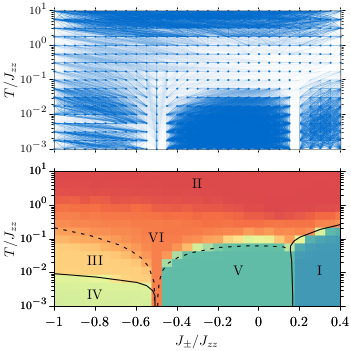 Facial recognition in airports and autonomous driving are two daily life examples of the recent progress in artificial intelligence. But can machines also facilitate the work of a physicist by independently interpreting experiments or simulations? In a series of papers building up complexity, we show that machine learning can successfully unravel the complex phase diagram found in classical Monte Carlo simulation of a highly frustrated magnet, identifying and correctly characterising all of the different phases present, without training or supervision (in collaboration with Ludovic Jaubert, Han Yan, and Nic Shannon). The method used is interpretable, and provides analytic expressions for the order parameters of each of the broken symmetry phases. It also provides analytical expressions of the local constraints that characterize each spin liquid, and underpin their topological properties. This work shows machine learning can mature into a trustworthy tool for exploring exotic phases in many-body systems.
References:
- Phys. Rev. B 99, 060404(R) (2019)
- Phys. Rev. B 99, 104410 (2019)
- Phys. Rev. B 100, 174408 (2019)
researchers : Rajah Nutakki, Lode Pollet ; previous : Dario Hügel
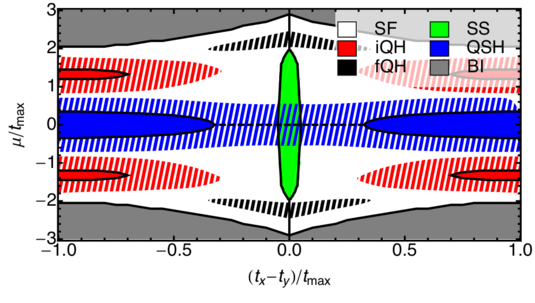 While being the method of choice for many bosonic problems, quantum Monte Carlo simulations suffer from an intractable sign problem in the presence of artificial gauge fields, frustration or real frequencies. This motivates the need for new approximate numerical methods such as bosonic dynamical mean-field theory, bosonic self-energy functional theory, and reciprocal cluster mean-field. In these methods an impurity (cluster) is solved numerically and consequently embedded into the original system. The interplay between topological band structures and strong interactions is currently hotly debated. In the figure we show the phase diagram of the Harper-Hofstadter-Mott model for hardcore bosons and magnetic flux π/2, indicating symmetry broken phases, fractional Chern insulators, and symmetry protected phases, among others.
References:
- Phys. Rev. B 94, 195119 (2016)
- Phys. Rev. B 96, 054431 (2017)
- New J Phys 20, 043001 (2018)
current researchers : Lode Pollet, previous : Stephen Inglis, Tobias Pfeffer
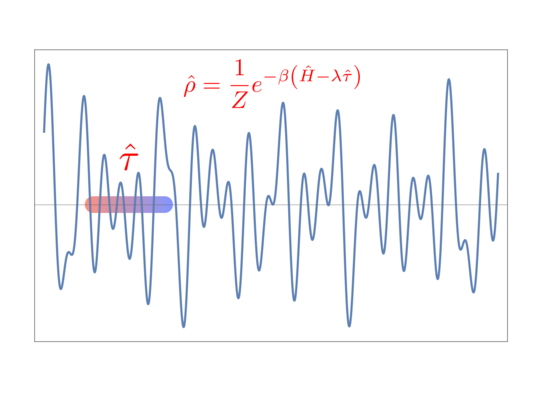 Our group has many years of experience in dealing with the ground state of disordered bosonic systems, featuring an ergodic phase as well as a non-ergodic glassy phase. Such phase diagrams have been obtained by path integral Monte Carlo simulations. The current frontier in this field is whether a generalized transition can also occur at finite energy and non-zero interaction strength. This is an intriguing question implying that there may exist a phase of matter which violates the eigenstate thermalization hypothesis of statistical mechanics and shows other unusual properties: The system would retain knowledge of its initial conditions, have a zero dc conductivity, and feature an area law, among others. A compelling description for this many-body localized phase is in terms of an extensive set of emergent local integrals of motion (see figure). We attempt to get an accurate description of those, and use them consequently in order to study the properties of excited eigenstates. Those are identified as ground states from a related system found by shifting the original action by the found local integrals of motion.
References:
- Phys. Rev. B 93, 094404 (2016)
- Phys. Rev. Lett. 117, 120402 (2016)
- Phys. Rev. B 99, 104514 (2019)
current researchers : Lode Pollet, previous : Tobias Pfeffer
Developing first-principles methods for strongly-interacting many-body systems remains an active field of research in theoretical physics. Quantum Monte Carlo algorithms based on the path integral formulation are often the method of choice because of their versatility. However, in the absence of a positive expansion scheme, Monte Carlo algorithms scale exponentially. This is the case for interacting Fermi systems without special symmetry and frustrated spin systems.
An alternative approach to study such systems are semi-analytical 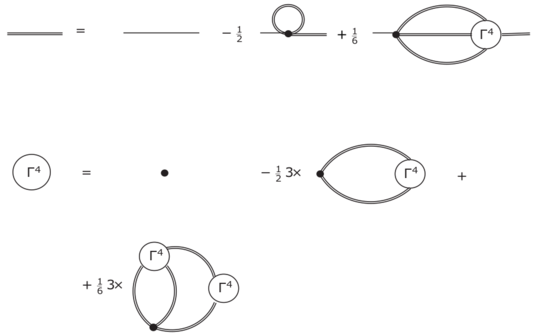 techniques such as resummed perturbation theory or other skeleton approaches. Most notably are Dyson-Schwinger equations and functional renormalization group equations. In our work we combine the Monte Carlo method with such semi-analytical approaches. The key concept used is this work is the expansion in rooted trees and stochastic summation of numerical root finding algorithms which can be used to solve integral equations or even more complicated functional integro-differential equations. The goal of this work is to overcome the main limiting factors of these skeleton approaches by using the Monte Carlo method.
The figure shows the leading terms in the Dyson-Schwinger expansion of the φ4 model.
References:
- New J Phys 19, 043005 (2017)
- Phys. Rev. B 98, 195104 (2018)
current researchers : Stefan Wittlinger, Tuomas Vanhala, Lode Pollet, previous : Peter Kroiss
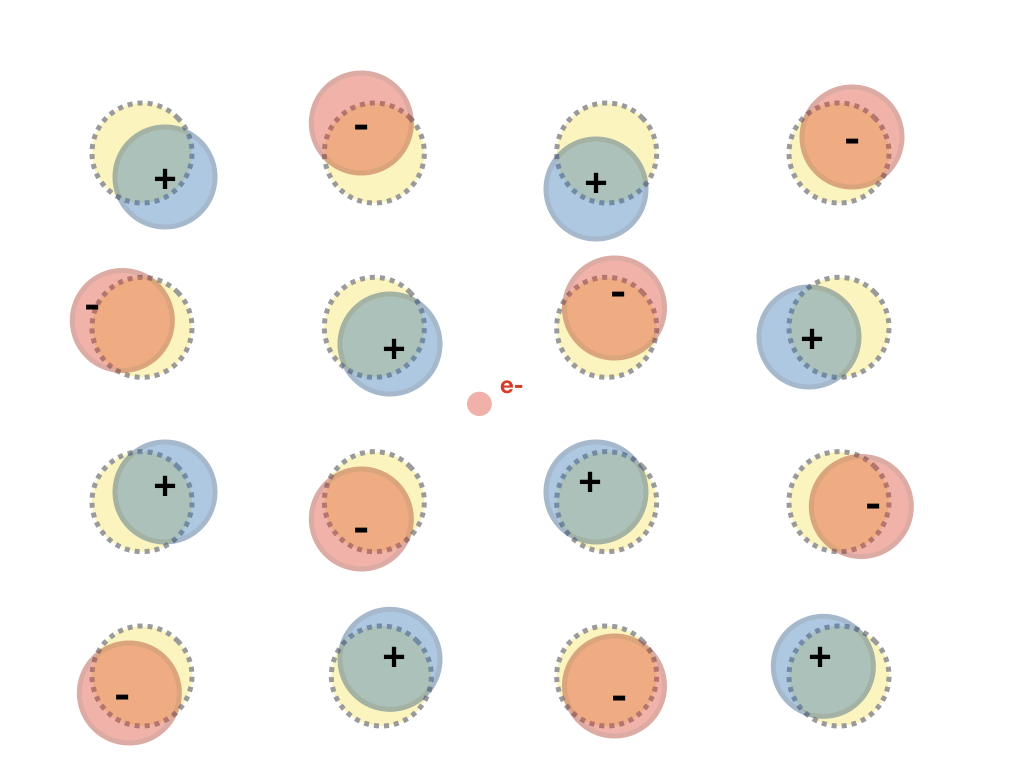 A single electron moving through a crystal interacts with the displaced ions. Landau, later elaborated by Frohlich, showed that the electron behaves as a quasi-particle: the electron drags a phonon cloud witht the property that ?
is composite object behaves almost as a free particle but with some renormalized parameters such as its mass and residue. Its thermodynamic properties are under good theoretical control, but transport properties such as its mobility remain poorly understood and provide an active field of research (also for different kinds of polarons such as Fermi-polarons). Understanding the mobility is of great importance for eg semiconductors such as the halide perovskites (photovoltaics).
References:
- Phys. Rev. B 90, 104510 (2014)
- Phys. Rev. Lett. 113, 195301 (2014)
- Phys. Rev. B 91, 144507 (2015)
- Phys. Rev. B 94, 075157 (2016)
- SciPost Phys. Lect. Notes 2 (2018)
- Phys. Rev. Lett. 123, 076601 (2019)
researchers: Tuomas Vanhala, Lode Pollet
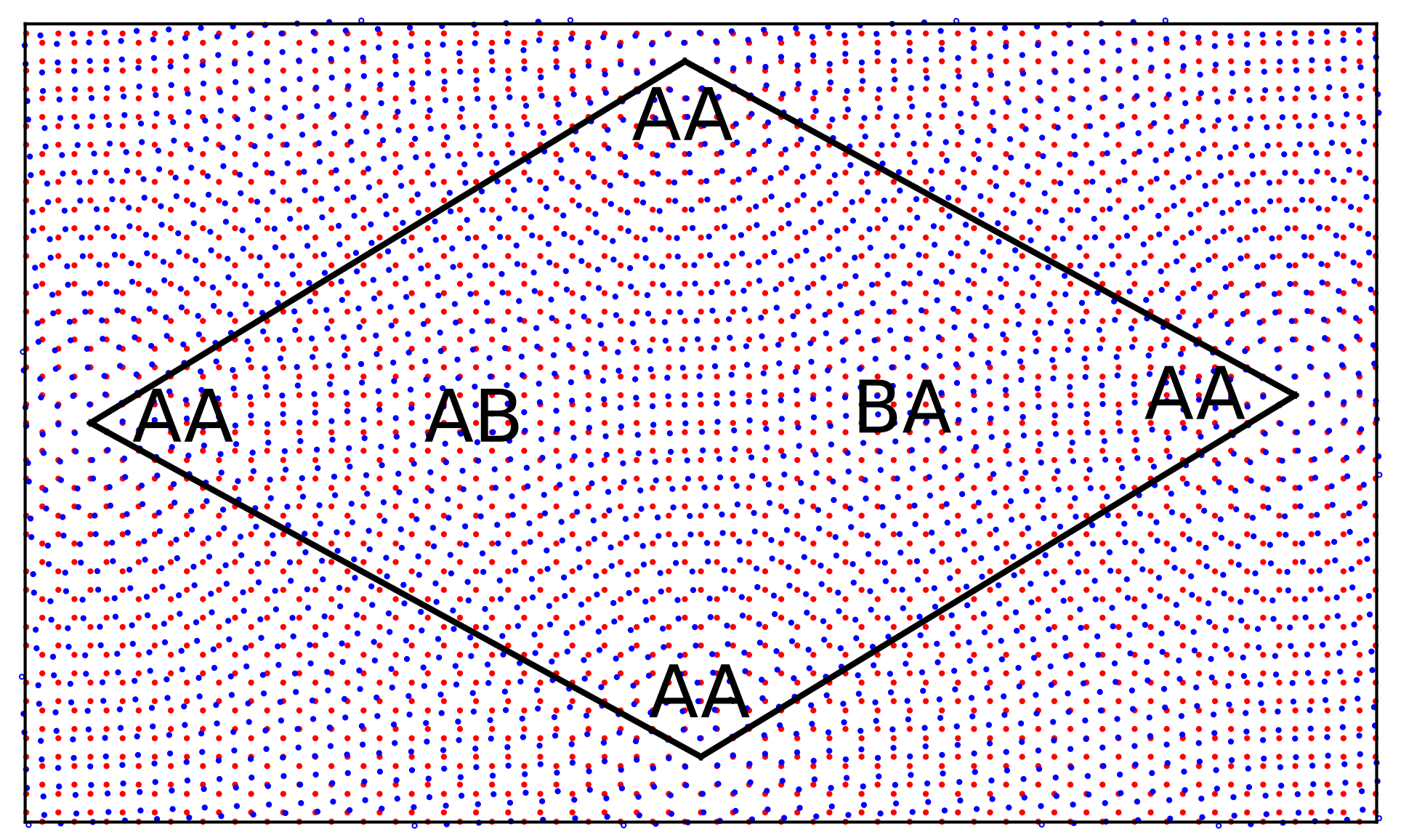 Aficionados of strongly correlated physics were thrilled by the discovery of correlated insulating states and superconductivity in magic-angle twisted bilayer graphene (MA-TBG) in 2018. The phase diagram shows certain similarities with the one of the cuprates but there are many distinct features. Debates continue on an effective model for this system, especially on the nature of the effective interactions and possible external screening effects. We have applied the constrained random phase approximation to study screening effects based on an atomic scale tight-binding model of TBG. This provides an estimate for the dielectric function and the strength of the effective Coulomb interaction entering the low-energy description.
References:
- arXiv:1909.09556
2022 – 2025
researchers : Rajah Nutakki, Ludovic D. C. Jaubert, Lode Pollet
The centred pyrochlore lattice is a novel highly geometrically frustrated model characterized by a rich phase diagram at low temperature. This was identified as the molecular design in metal-azolate framework [Mn(II)(ta)2], with the frustrated regime depending on the interplay between nearest neighbour and next-to nearest neighbour interactions (respectively with interaction strength J1 and J2). Through a combination of analytics, numerics and experiments we found that, at a particular interaction regime, the reciprocal space structure factor S(q) is characterized by finite width bowties, also referred to as pinch points, which are found to arise from the correlations between spins residing at the vertices of the tetrahedra. The width of these bowties was found to scale linearly with the ratio γ ≡ J1 /J2 up to γ=1.25. The study is currently being extended to a other MOFs and to other 2D centered lattices such as the centered Kagome lattice.
References:
- Phys. Rev. B 112, 144437 (2025)
- SciPost Phys. 15, 040 (2023)
- Phys. Rev. Research 5, L022018 (2023)
Tangle of Spin Double Helices in the Honeycomb Kitaev-Γ Model
researchers : Jheng-Wei Li, Nihal Rao, Jan von Delft, Ke Liu, Lode Pollet
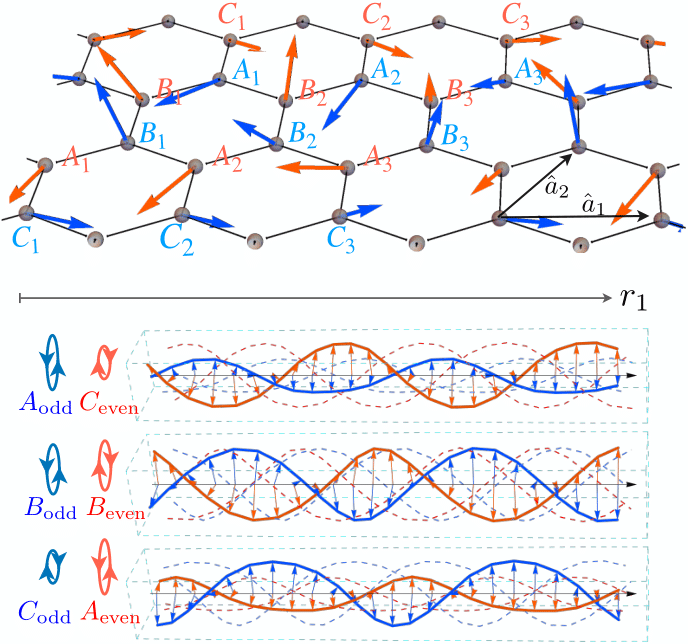
The honeycomb Kitaev-Γ Hamiltonian is a paradigmatic model for the physics of two-dimensional Kitaev magnets. The Kitaev exchange leads to an exactly solvable spin liquid and can be realized in d-electron transition-metal compounds with edge-shared geometry. However, symmetries of real materials permit a generic existence of a Heisenberg and an off-diagonal Γ term which may dramatically modify the desired spin-liquid ground state. Using infinite projected entangled pair states (iPEPS) to investigate the honeycomb Kitaev-Γ model in material relevant regimes, we discovered that the classical ground state imprints a tangle of emergent spin double helices. This unprecedented many-body order is characterized by anisotropic periodicities and a sgn(Γ)-determined chirality pattern. The emergence of this helicity may give rise to peculiar dynamical and transport behaviors, such as spectrum broadening and splitting, long-living currents and anomalous diffusions.
References:
- arXiv:2206.08946, to appear in Phys. Rev. B
- Phys. Rev. Research 3, 033223 (2021)
current researchers : Giovanni Canossa, Hao Song, Ke Liu, Miguel A. Martin-Delgado, Lode Pollet
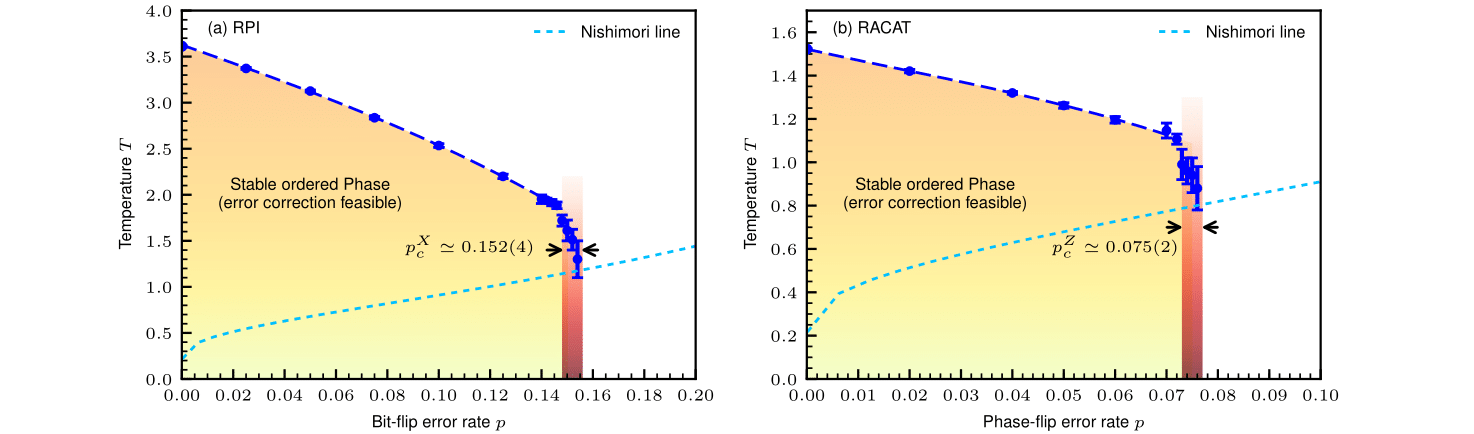
Surface codes are heavily studied in the field of quantum error correction (QEC) due to the high resilience to errors introduced by their characteristic topological protection, which is reflected in their optimal error threshold. So far, toric code and color code are known to offer high error thresholds in 2D. Due to their peculiar interplay between subsystem symmetries and topological order, fracton models represent optimal candidates for efficient QEC in 3D. An example is the X-cube model, which was shown to have a resilience against X- and Z- errors up to an error probability of 15.2% and 7.5% respectively. These results represent a first step towards the investigations of the resilience to errors of different fracton models and bring attention to their theoretical applicability to quantum computation in 3D.
References:
- Phys. Rev. Lett. 129, 230502 (2022)
researchers : Marc Machaczek, Ke Liu, Miguel A. Martin-Delgado, Lode Pollet
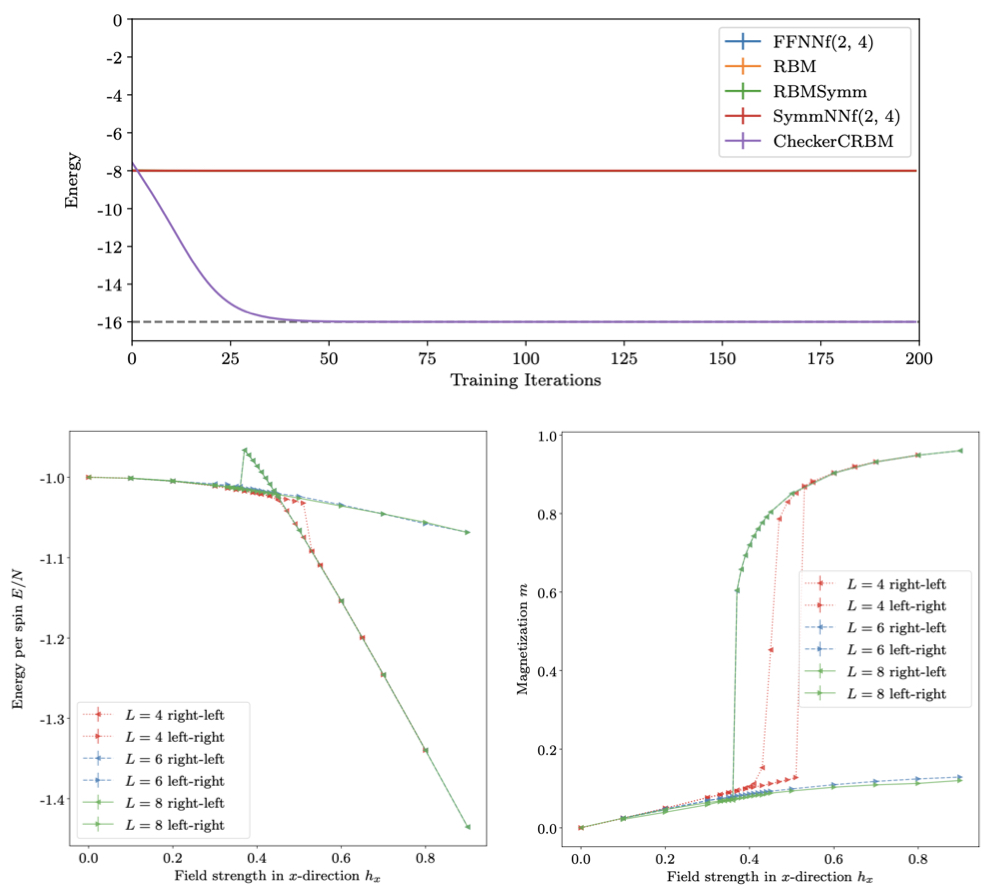
Fracton models recently began to attract a lot of interest due to their rich theoretical description of beyond conventional topological order and their potential use as robust quantum memory. However, the stability of fracton phases with respect to local perturbations is not yet fully explored, partly due to the difficulty of simulating such three-dimensional, highly entangled systems numerically. Using different variations of restricted Boltzmann machines, we were able to succesfully show how neural network quantum states enable the exploration of the phase diagram for the Checkerboard model.
References:
- SciPost Phys. 18, 112 (2025)
2016 – 2018
Researchers : Ke Liu, Dario Hügel, Tobias Pfeffer, Sebastian Schulteß, Jonas Greitemann, Janik Schönmeier-Kromer, and Lode Pollet
We are interested in the phenomenology of cold atomic systems in a wide variety of settings. First, we explore the possibilities a microscope offers to the experimental study of cold fermionic samples aiming at identifying novel types of magnetism and superfluidity in Hubbard-like models. Second, we study the behavior of quantum systems in the presence of inhomogeneous conditions, either in space or in time, when they are close to a phase transition. Third, we are interested in the hydrodynamic description of multi-component superfluids and superfluid drag. The main tools are the renormalisation group theory of critical phenomena, numerical simulations (primarily quantum Monte Carlo and exact diagonalization), and the hydrodynamic theory of superfluidity.
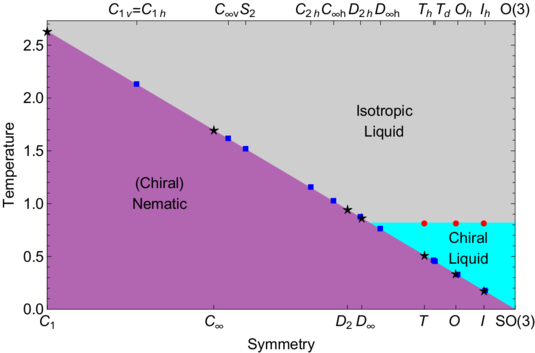 Spontaneously breaking a large symmetry to its subgroups can lead to phases characterized by orders with an internal symmetry. Very often these phases possess non-trivial thermodynamical and topological properties. They are ubiquitous in both classical and quantum systems such as nematic phases in assembly of molecules, fluids of correlated electrons, and systems of spinor atoms. However, they remain largely unexplored, especially for those involving non-Abelian symmetries. We are interested in condensed matter systems and theoretical models that support such phases, in particular their realization in quantum regimes. The methods we use are based on lattice gauge theories, which appear to be convenient and mighty tools when traditional approaches become cumbersome.
Many-body calculations for correlated-electron systems pose a long-standing challenge in condensed matter physics. The main difficulty in such calculations stems from the long-range nature of the Coulomb interaction. This, for instance, manifests in a perturbative treatment of the homogeneous electron gas (jellium model), where certain classes of diagrams diverge. From a physical point of view one wants to understand collective phenomena such as the effective screening of the electron-electron interaction. A textbook example of a simple approximation, which tries to capture this physics and partly resolves the divergencies, is the so-called random phase approximation. It turns out to quite accurately reproduce the ground state energy of the electron gas at high densities. However, an accurate solution for a wider range of densities is of crucial interest, as jellium, while itself being a basic model for electrons in a solid, is also the starting point for more elaborate electronic structure calculations within density functional theory.
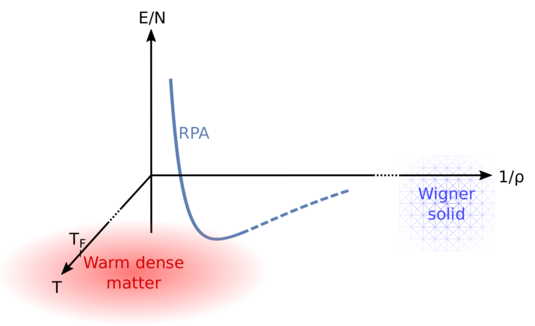 Expanding upon this is the idea of a series of skeleton diagrams, where all divergent contributions are excluded from the series, but are implicitly incorporated via a self-consistent scheme. This self-consistency can be combined with the technique of Diagrammatic Monte Carlo to evaluate higher-order diagrams. We investigate the applicability for various densities and temperatures, from the ground state up to the region of warm dense matter, depending on the convergence (or asymptotic) properties of the underlying series at the given regime.
The interaction of electrons with the crystal lattice gives rise to a multitude of interesting phenomena. The Coulomb attraction between a single impurity and vibrations of the lattice can be described within the Froehlich model, resulting in an expansion in terms of Feynman diagrams where the electron is dressed by phononic excitations, giving rise to a quasiparticle, the polaron, composed of the electron and its surrounding phonon cloud.
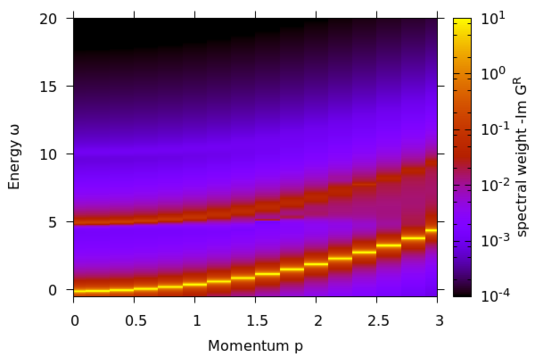 Diagrammatic Monte Carlo is routinely used to sample this diagrammatic series stochastically in imaginary time where the expansion is free of sign problems. The ground-state energy of the polaron has been extracted from the asymptotic behavior of the polaron Green's function in imaginary time. However, to access the excitation spectrum one has to rely on analytic continuation which is numerically ill-posed and prone to spurious spectral features. We aim to bypass the analytic continuation by sampling the diagrammatic series directly in real time (see figure). In order to manage the resulting severe sign (phase) problem, non-crossing diagrams are summed up self-consistently and the resulting bold propagator is used to sample the remaining crossing diagrams more efficiently.
2012 – 2015
-
We are applying numerical methods to strongly correlated physics in cold atomic and condensed matter systems. We are interested in open systems, entanglement properties, dimensional crossovers, supersolids and Helium-4, and also disordered systems.
-
We are working on the development of new algorithms suitable for strongly correlated systems. These include advances in (diagrammatic) Monte Carlo methods and the dynamical cluster approximation (DCA). Often a strong analytical component is required to make progress.
Get in touch
|
Prof. Dr. Lode Pollet Theoretical Nanophysics · LMU Munich Theresienstr. 37 · Room A 405 · 80333 Munich Tel. +49 89 2180-4593 · lode.pollet@physik.uni-muenchen.de |