

Turing Foams and Turing Mixtures
Many cellular processes rely on striking spatial patterns of proteins that constantly assemble and disassemble on membranes. In our new study, published in Nature Physics, we show that these active protein patterns can behave like foams and multicomponent liquid mixtures, even though there are no mechanical forces between the molecules. We introduce the concepts of “Turing mixtures” and “Turing foams” and develop a theory that predicts how their interface geometry and typical length scale are selected.
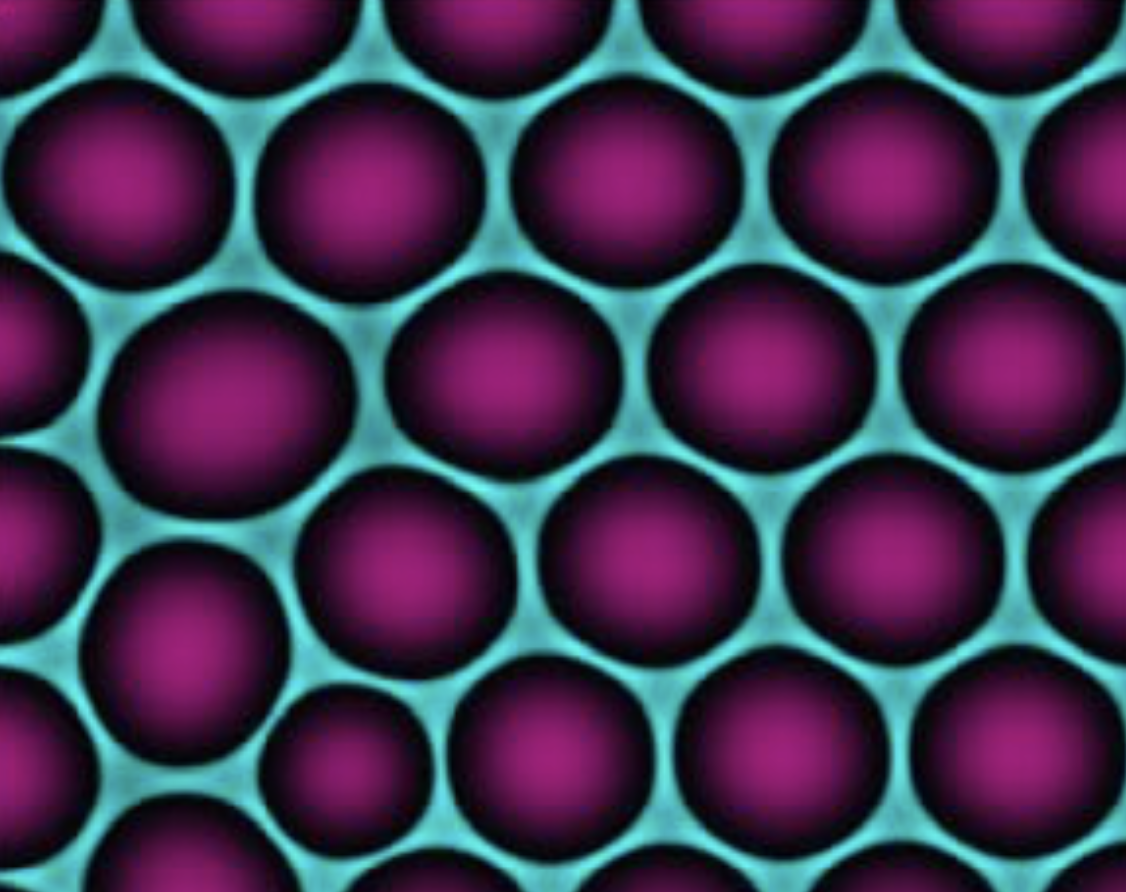 The key idea is that cyclic attachment and detachment of proteins at pattern interfaces acts like an effective interfacial tension, tending to straighten and shorten interfaces, much like surface tension in ordinary liquids. From this mechanism, we derive non-equilibrium versions of classical interface laws, including a Gibbs–Thomson relation, a Neumann angle law, and Plateau rules that fix the 120° junction angles in foam-like networks. We apply this framework to the paradigmatic Min protein system from E. coli and show that its mesh-like patterns on membranes are a clear example of a Turing foam, with statistics closely matching our theoretical predictions and simulations. Remarkably, unlike ordinary foams and mixtures that coarsen indefinitely, Turing foams in the Min system exhibit “interrupted coarsening”: domain growth is halted, and large domains split again, setting a characteristic pattern wavelength. Our analysis also demonstrates that similar Turing foams arise in classical chemical reactions such as the ferrocyanide–iodate–sulfite system and in generic reaction–diffusion models, pointing to a mechanism that is not restricted to mass-conserving protein systems. By connecting far-from-equilibrium reaction networks to simple geometric interface laws, the work provides a bridge between biochemical detail and the large-scale morphologies observed in cells and synthetic active matter. In the long run, this understanding may help us rationally design protein and chemical patterns with tailored shapes and length scales, for example, as spatial control modules in synthetic cells or programmable active materials.
Related Links
- Nature Physics.
- LMU Press Release in German
- LMU Press Release in English.