

Decoding the Arrow of Time in Living Tissue
The international research consortium ALIVE, involving LMU physicist Erwin Frey, has secured 10 million euros in funding.
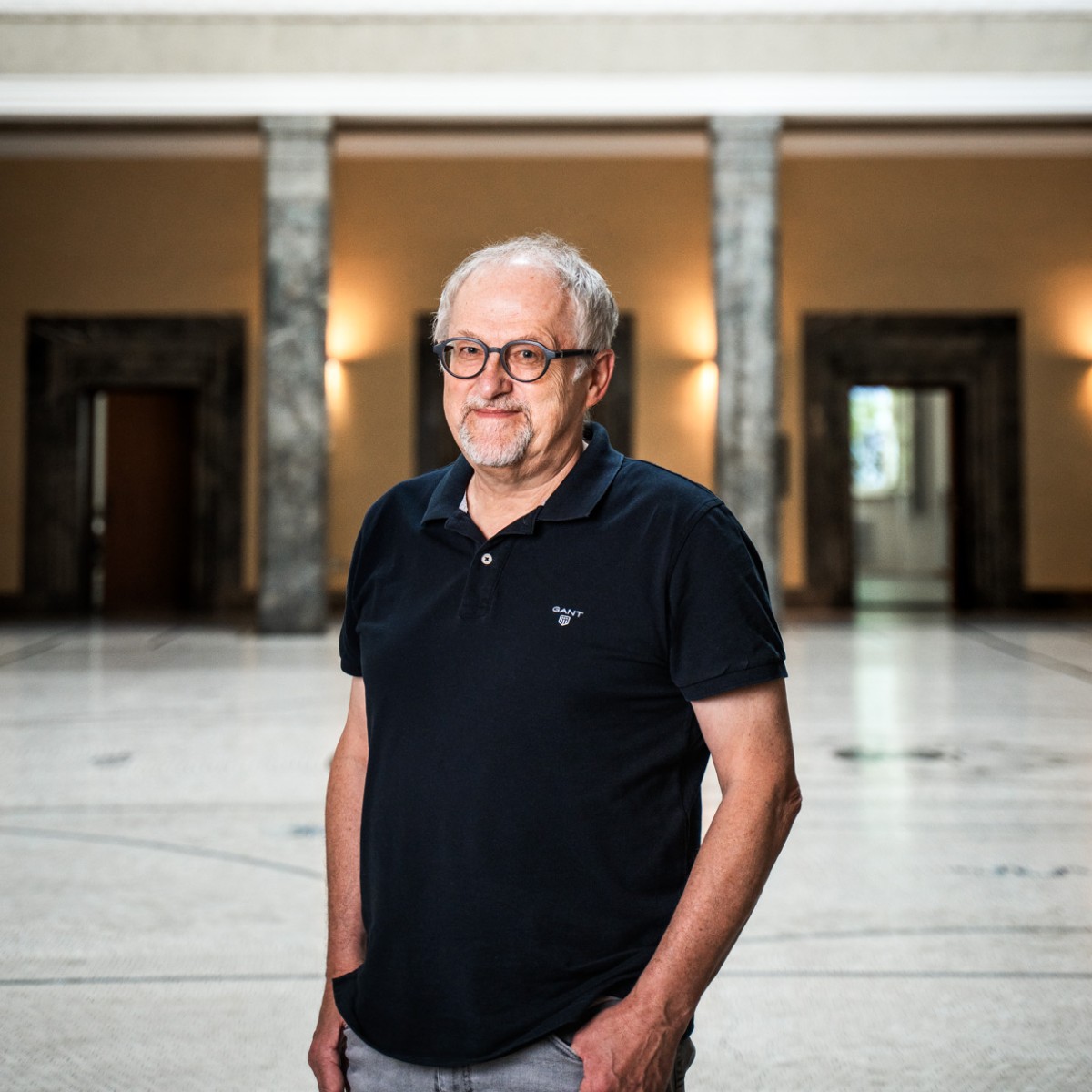
An international consortium including LMU physicist Erwin Frey has been awarded a €10 million grant from the Novo Nordisk Foundation to build the physics that predicts — and steers — how living tissues form, stay healthy, and fail. About a quarter of the grant amount—approximately 2.5 million euros—goes to LMU.
“This funding demonstrates that pioneering research is taking place here, research that enables true innovation. It embodies what makes LMU unique: internationality, interdisciplinarity, and excellence—by combining groundbreaking experiments—long-term live imaging, measurements of the forces cells exert on one another, and optical and genetic tools to gently influence cells—with new physical theories,” says Prof. Dr. Benedikt Grothe, neurobiologist and vice president of LMU.
Living tissues are among nature's most remarkable machines. Thousands of cells coordinate — with no central controller and no fixed blueprint — to build an embryo, to renew the lining of the gut day after day, and, when this coordination breaks down, to drive diseases such as cancer. How cells achieve this collective feat, and why it sometimes fails, remains one of the deep open questions at the border of physics and biology.
The new research consortium, ALIVE — the Center for Active Living Matter (Information, Vitality, and Emergence) — aims to answer this question with the funding from the Novo Nordisk Foundation. Among its four principal investigators is Professor Erwin Frey, theoretical physicist at the Arnold Sommerfeld Center for Theoretical Physics, LMU Munich and member of the ORIGINS Cluster of Excellence.
“Classical physics describes systems in terms of their states of equilibrium—but living tissue functions precisely because it remains far from equilibrium.” — Erwin Frey
Over the next six years, the team will work to uncover the physical laws behind tissue self-organization and turn them into practical tools to forecast — and ultimately steer — whether a tissue grows, heals, or deteriorates.
“Classical physics describes systems in terms of their states of equilibrium—but living tissue functions precisely because it remains far from equilibrium,” says Erwin Frey. “That is why we are developing our own theoretical framework for this: mathematical tools that quantify and describe the temporal direction of life based on experimental data, and along which a tissue actually organizes itself.”
Life runs in one direction
The starting point is a simple but powerful idea. Living systems are never truly at rest: they constantly consume energy, and this gives their behavior a built-in direction in time — an “arrow of time.” A healthy tissue developing or repairing itself looks unmistakably different from one running in reverse, just as a film of a shattering glass looks obviously wrong when played backward. ALIVE proposes that this time-directionality is not a mere side effect but a measurable fingerprint of how living matter is organized — and, crucially, a handle that can be used to control it.
To make this rigorous, the consortium will track the “flows of information” that cells exchange through forces, chemical signals, and gene activity, and follow how these flows travel across scales — from single molecules inside a cell up to the mechanics of an entire tissue.
From the origins of multicellular life to cancer
The team will test its ideas in four complementary biological systems that together span the story of multicellularity: sea sponges, among the most ancient multicellular animals; human embryoids, lab-grown models of early development; intestinal organoids, miniature self-renewing “guts”; and colorectal cancer organoids, models of disease. Across all four, cutting-edge experiments — long-term live imaging, measurements of the forces cells exert on one another, and optical and genetic tools to gently nudge cells — will be combined with new physics theory.
The role of LMU
Frey's group provides the theoretical backbone. Building on LMU's strengths in non-equilibrium statistical physics, the Munich team is developing the mathematics needed to quantify life's arrow of time, together with a new organizing concept the consortium calls “functional manifolds”: maps that describe how a tissue moves between stable states far from equilibrium, replacing the equilibrium-based pictures that physics has traditionally relied on.
“Our group has long pursued the vision of developing a theory for systems beyond equilibrium,” says Erwin Frey. “We began by seeking to better understand pattern formation in biological systems and to develop a theory that goes beyond Turing’s classical approach—we have largely succeeded in this, and the work is funded by my ERC Advanced Grant. Now it’s time for the next step: understanding how, building on this foundation, we can also comprehend living tissue. In addition to new theoretical methods, we’re also using computer simulations and machine learning for this purpose.”
Specifically, the team is developing methods to directly extract this temporal direction from measurement data—such as from so-called probability currents and directed information flows, which can be obtained from long-term imaging as well as from force and gene activity measurements. From such high-dimensional data, the researchers derive “functional manifolds”: reduced descriptions that, despite significant simplification, preserve precisely the non-equilibrium structure that keeps a tissue functional. Because living tissue operates permanently far from equilibrium, such models go beyond the equilibrium-based pictures on which physics traditionally relies.