


Contact
Room:
A 405
Phone:
+49 89 2180-4593
Email:
lode.pollet@physik.uni-muenchen.de
|
Pollet Group · Theoretical Nanophysics
Quantitative answers for strongly correlated quantum matter
First-principles computational methods at the boundary of ultracold atoms, condensed matter and computational physics.
|
3 research fields | 4 core methods | 2011 in Munich since |
 |
 Quantum Matter |
 Quantum Simulation |
Where three fields meet
The research in our group is situated at the boundary between cold gases, condensed matter and computational physics. We are interested in first-principles quantitative approaches to strongly correlated many-body systems. Combining these three fields often offers a new perspective on long-standing problems. |
What we work on
Cold Gases Ultracold atoms as quantum simulators: clean, tunable and controllable. We deliver the quantitative benchmarks these analog devices need. | |
Condensed Matter Helium-4 and supersolids, disordered bosons and the Bose glass, dimensional crossovers, Rényi entropies and entanglement. | |
Numerical Methods Quantum Monte Carlo and embedding techniques – from worm-type path integrals to sampling the Feynman series. |
Benchmarking quantum simulators
Cold gases are ideally suited to implement prototypical strongly correlated models in an experiment, thanks to their cleanliness, tunability and the control one has over them – they can be used as quantum simulators. We provide a quantitative description of such systems in order to perform the necessary benchmarking of these analog devices, successfully done for a variety of systems in different contexts. |
Schematic phase diagram of the Bose–Hubbard model: Mott-insulating lobes and the superfluid phase. |
Supersolids, disorder and entanglement
A supersolid is an elusive phase of matter that simultaneously displays crystalline and superfluid order. Quantum mechanics allows it, but it is hard to find experimentally. Solid Helium-4 had been suggested as a prime candidate, yet consensus is growing that it remains an insulator – although defects such as grain boundaries and dislocations may under certain conditions support superflow.
Bose glass Disordered bosons: compressible and gapless, but nevertheless an insulator. |
Dimensional crossovers For bosons and fermions, relevant for low-dimensional (super)conductors. |
Entanglement Rényi entropies and entanglement properties of many-body systems. |
The right tool for each problem
Algorithmic and technical advances in numerical methods are often needed to arrive at new results. PIMC works extremely well for bosonic systems, whereas detMC is well suited for fermionic systems at half filling; for general fermionic problems both fail because of the sign problem.
| Method | Bosons | Fermions, half filling | General fermions |
|---|---|---|---|
| Path integral Monte Carlo | ● | ○ | ○ |
| Worm-type updates; extremely efficient for bosons | |||
| Determinant Monte Carlo | ○ | ● | ○ |
| Fails for general fermions due to the sign problem | |||
| Diagrammatic Monte Carlo | ◐ | ◐ | ◐ |
| Samples the Feynman series; sign problem not volume dependent | |||
| DMFT & cluster extensions | ● | ● | ● |
| Self-consistent cluster solution, extrapolated in cluster size | |||
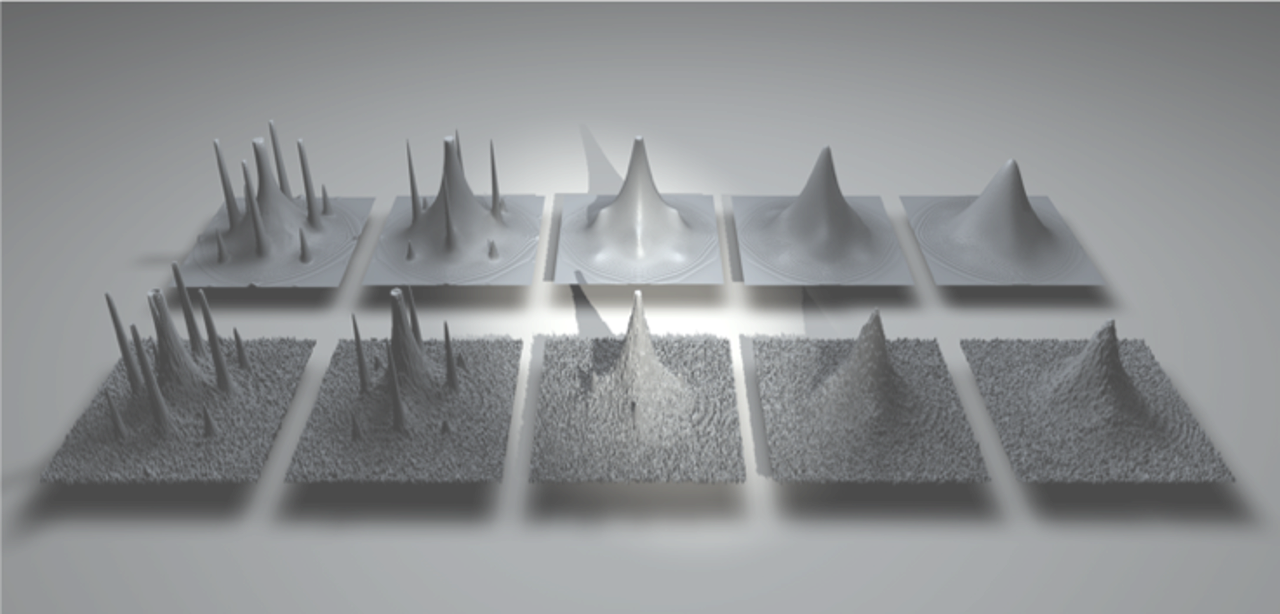
With diagrammatic Monte Carlo we explore what a sampling of the Feynman series – whose sign problem is not volume dependent – can offer for strongly correlated systems. In the DMFT approach the system is solved self-consistently for a small cluster while preserving information in the Matsubara domain. If big enough clusters can be studied, the thermodynamic answer may be found after extrapolation in the cluster size. |
Schematic: extrapolation in cluster size towards the thermodynamic limit. |
Recent work
11 Mar 2026 · Physical Review B J.-W. Li, N. Rao, J. von Delft, L. Pollet, K. Liu · doi:10.1103/cglm-2ctt |
12 Feb 2026 · PRX Quantum S. M. Linsel, L. Pollet, F. Grusdt · doi:10.1103/gtth-cclr |
26 Jan 2026 · PNAS T. Chalopin, P. Bojovic, S. Wang, T. Franz, A. Sinha, Z. Wang, D. Bourgund, J. Obermeyer, F. Grusdt, A. Bohrdt, L. Pollet, A. Wietek, A. Georges, T. Hilker, I. Bloch · doi:10.1073/pnas.2525539123 |